No complaints, not doing well: how to spot and build athlete wellbeing
No complaints doesn't mean an athlete is doing well. What languishing and flourishing are, and how staff can spot and build wellbeing.
I still hear athletes and performance staff say: "Everything's going well, no problems, so no need for mental work." But an athlete, or anyone, can have no diagnosis at all and still be unhappy. And mental work isn't only there for people with problems. It could serve as a performance enhancer, just like good nutrition and physical training. Same goes for people in a normal job, by the way.
So if you only look for complaints or symptoms, you'll miss two things: the athletes who aren't struggling but aren't doing well either, and the chance to help people perform better when it counts. Personally, I think the two are linked: better wellbeing might well lift performance too.
Wellbeing and mental illness
The International Olympic Committee's 2026 consensus statement describes athlete mental health as a line running from optimal wellbeing to symptoms and disorders. The IOC calls on sport organisations to promote wellbeing as well as prevent and treat problems (IOC consensus statement, 2026).
The IOC adds that athletes in an unsupportive environment can struggle even without any history of symptoms. Sociologist Corey Keyes described this back in 2002, with a model of two separate scales, one for mental health, one for mental illness.
I call the mental health scale wellbeing. Not because "mental health" is wrong, but because in my experience "wellbeing" sounds less like a problem, so people are more open to talking about it.
(1) Wellbeing runs from languishing (life feels flat and stagnant, it just drags you along) to flourishing (life feels full and connected, you're moving in the directions you want, you're in the driver's seat). Wellbeing isn't just the absence of problems; it's the presence of positive feelings and functioning well (Keyes, 2002), in three parts: emotional (enjoyment, interest, satisfaction), social (belonging, feeling you contribute) and psychological (direction, growth, a sense of control).
(2) Symptoms run from none, to some, to a diagnosable illness or disorder.
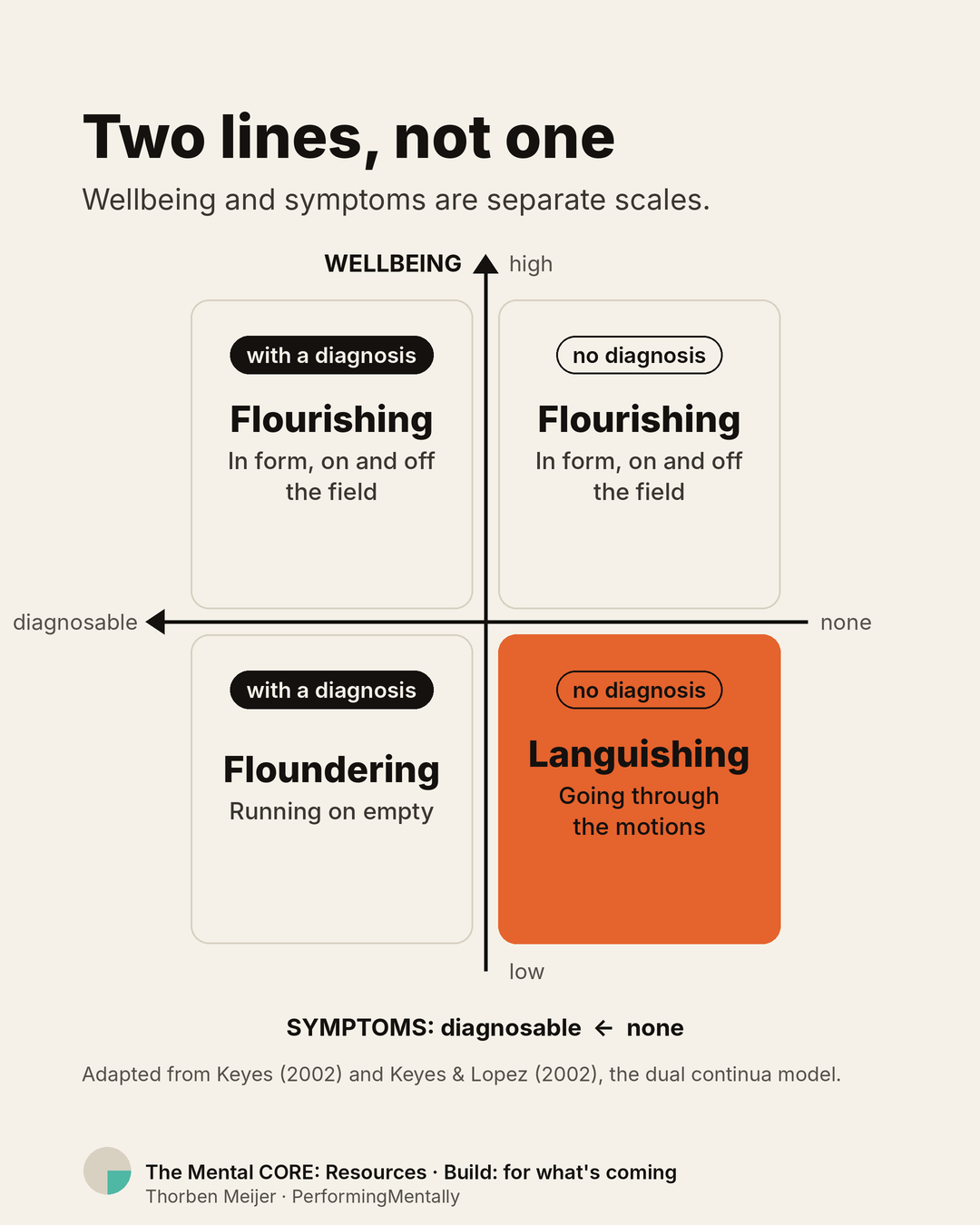
In short, you can have a diagnosis and still feel like you're grabbing life with both hands, and be content. Equally, you can be free of symptoms and still not feel content with life and the things you do or experience.
Researchers in sport psychology have argued for using Keyes' model with athletes, partly because it gives a way to talk about mental health without starting from illness (Uphill et al., 2016). In a study of Canadian university athletes, 18% reported a previous diagnosis and still kept moderate wellbeing over time: symptoms and good wellbeing at the same time (Van Slingerland et al., 2018).
If we only look at symptoms or no symptoms, we make it hard for athletes to work on their mind, because it sounds like admitting something is wrong with them. I once worked somewhere a department was called Mental Care, not Mental Performance. For me, that one word shows the difference between the two scales. Ask yourself which door athletes, or people in general, would rather knock on.
Does wellbeing affect performance?
I'd like to believe it can help with performance and possibly longer careers. But belief isn't evidence :).
In sport more broadly, high wellbeing and a high sense of performance often go together (Brown et al., 2017), but athletes rated their own performance, and nobody has shown yet that raising wellbeing raises performance.
Can you train wellbeing?
A 2025 meta-analysis of interventions with elite athletes found that psychological skills training, positive psychology interventions and third-wave interventions (such as ACT) were potentially effective in improving wellbeing (Wang et al., 2025).
What can that look like? Two examples of the kinds of exercises involved (illustrations, not the exact study protocols):
- Personal meaning: an athlete writes down why the sport matters to them and what they want to be known for, as a teammate and as a person, beyond results. That gives direction when results dip, and an identity that doesn't hang on the last game.
- Acceptance: instead of fighting pre-match nerves ("I shouldn't feel this"), the athlete notices them, names them ("there are the nerves again") and still does what matters: the warm-up routine, the first sprint.
What the wellness form doesn't see
Some teams ask athletes to fill in a daily wellness form. Most versions ask about fatigue, sleep quality, muscle soreness, stress and mood (McLean et al., 2010; Hooper & Mackinnon, 1995). You track how athletes respond to training load.
Useful for tracking recovery. But next to Keyes' three parts, it only covers part of emotional wellbeing, and very little of psychological or social wellbeing: direction, growth, belonging, contributing. Even the stress question sits on the symptoms side: no stress doesn't mean good wellbeing.
These questions can measure how tired someone is. Not whether they still care and feel content.
(This comparison is my own reading of the questionnaires against Keyes' model, not a finding from a study.)
What can you do: notice the signs, and ask
In a study following adults for about ten years, people whose wellbeing dropped were more likely to develop mental health problems later (Keyes, Dhingra & Simoes, 2010). Not athletes, but the lesson travels: a drop in wellbeing is worth noticing before things might get worse.
Can you see an athlete's or colleague's wellbeing from the outside? Partly. A meta-analysis found a moderate match between how people rate their own wellbeing and how people who know them rate it (Schneider & Schimmack, 2009). The match grows over roughly the first three years of knowing someone (Schneider et al., 2010). Those studies looked at friends and partners, not staff and athletes, but it's a sign that you can pick up wellbeing signals with others.
So besides noticing, ask.
Below: signs you might notice and questions you can ask, per part of wellbeing. Suggestions to adapt, not a validated checklist.

What you can observe is behaviour: someone who used to ask questions in video sessions and stopped. What's behind it, you can't see from the outside. So treat it as a conversation starter, and say why you're asking: you're interested in how they're doing, and that's it.
If you want something more structured, there's a short questionnaire built on Keyes' model: the Mental Health Continuum Short Form (14 questions).

Where the line is
Noticing wellbeing is not diagnosing. If what you see or hear points towards the symptoms scale, the next step is the team doctor or a clinical colleague.
And you?
Everything above applies to staff, your employees and leadership too. Long seasons, travel, results you don't control. So before you start asking others where they sit, check where you are yourself.
Sources
- Brown, D. J., Arnold, R., Standage, M., & Fletcher, D. (2017). Thriving on pressure: A factor mixture analysis of sport performers' responses to competitive encounters. Journal of Sport and Exercise Psychology, 39(6), 423–437. Full text
- Hooper, S. L., & Mackinnon, L. T. (1995). Monitoring overtraining in athletes: Recommendations. Sports Medicine, 20(5), 321–327. https://doi.org/10.2165/00007256-199520050-00003
- International Olympic Committee (2026). Mental health in elite athletes: International Olympic Committee consensus statement (2026). British Journal of Sports Medicine. https://doi.org/10.1136/bjsports-2025-111514
- Keyes, C. L. M. (2002). The mental health continuum: From languishing to flourishing in life. Journal of Health and Social Behavior, 43(2), 207–222. https://doi.org/10.2307/3090197
- Keyes, C. L. M. (2009). Mental Health Continuum–Short Form (MHC-SF). Overview and items: Measures of Wellbeing database, University of Connecticut
- Keyes, C. L. M., Dhingra, S. S., & Simoes, E. J. (2010). Change in level of positive mental health as a predictor of future risk of mental illness. American Journal of Public Health, 100(12), 2366–2371. https://doi.org/10.2105/AJPH.2010.192245
- McLean, B. D., Coutts, A. J., Kelly, V., McGuigan, M. R., & Cormack, S. J. (2010). Neuromuscular, endocrine, and perceptual fatigue responses during different length between-match microcycles in professional rugby league players. International Journal of Sports Physiology and Performance, 5(3), 367–383. https://doi.org/10.1123/ijspp.5.3.367
- Schneider, L., & Schimmack, U. (2009). Self-informant agreement in well-being ratings: A meta-analysis. Social Indicators Research, 94(3), 363–376. https://doi.org/10.1007/s11205-009-9440-y
- Schneider, L., Schimmack, U., Petrican, R., et al. (2010). Acquaintanceship length as a moderator of self-informant agreement in life-satisfaction ratings. Journal of Research in Personality. https://doi.org/10.1016/j.jrp.2009.11.004
- Uphill, M., Sly, D., & Swain, J. (2016). From mental health to mental wealth in athletes: Looking back and moving forward. Frontiers in Psychology, 7, 935. https://doi.org/10.3389/fpsyg.2016.00935
- Van Slingerland, K. J., Durand-Bush, N., & Rathwell, S. (2018). Levels and prevalence of mental health functioning in Canadian university student-athletes. Canadian Journal of Higher Education, 48(2). https://doi.org/10.7202/1057108ar
- Wang, W., Schweickle, M. J., Arnold, E. R., & Vella, S. A. (2025). Psychological interventions to improve elite athlete mental wellbeing: A systematic review and meta-analysis. Sports Medicine, 55(4), 877–897. https://doi.org/10.1007/s40279-024-02173-3