How talented athletes learn more from every training session
Talented athletes don't just train more: they tend to plan, check and look back on their sessions. How that learning loop works, where the research stops, and how to start.
Training ends. Some athletes go straight to the coach with a quick question about how they're doing. Some go home and write the session down in a journal. And some go straight home.
Who has the best chance of getting better this season?
In my sessions, every athlete tells me they want to get better. Far fewer have an idea of how to improve in a structured way. There's usually a strong focus on getting things right, physically, technically, tactically and mentally, but no real plan for how to develop yourself and how to use all those training hours as well as possible.
Studies of talented young athletes point the same way. Players at higher levels tend to plan their training, check in with themselves during practice, and reflect on their training and performances afterwards (Toering et al., 2009; Reverberi et al., 2021). These studies measure at one moment, so we don't know whether reflecting gets players to the top or the top makes them reflect; probably both. In psychology, this is called self-regulated learning. I want the athletes I work with to learn exactly that skill: learning. With a clear goal, they use the information they have and turn it into a plan to improve, instead of just showing up, doing the drills and putting in hours without knowing where it should lead them.
More hours isn't the whole story
The total amount of training matters. But being deliberate about what you want to train and improve, and being able to put that in a plan (and stick to it), is what turns those hours into progress. Telling yourself "I want to get better" won't get you very far. And in professional sport, everyone around you trains a lot, so hours alone won't set you apart.
Side path: the 10,000-hour myth. The 10,000-hour rule was adapted from a violin study, but the original study never claimed that 10,000 hours is the threshold for excellence (Ericsson et al., 1993). A 2019 replication found the best violinists hadn't practised more than the good ones (Macnamara & Maitra, 2019).
Before you start: three layers of goals
Self-regulated learning starts with a goal. You need to know what you want, and why, before you can work out how. Goals come in three layers: outcome, performance and process (Hardy, Jones & Gould, 1996). In a meta-analysis of 27 sport studies, process goals helped performance most and outcome goals least (Williamson et al., 2022). Taking a tennis serve as the example:
- Outcome: win the match.
- Performance: get 70% of first serves in.
- Process: toss the ball slightly in front of you, every serve.
The learning loop: before, during, after
The educational psychologist Barry Zimmerman (2000) described learning as a loop with three phases. Like any skill, you get better at it with practice, and each phase has its own trap.
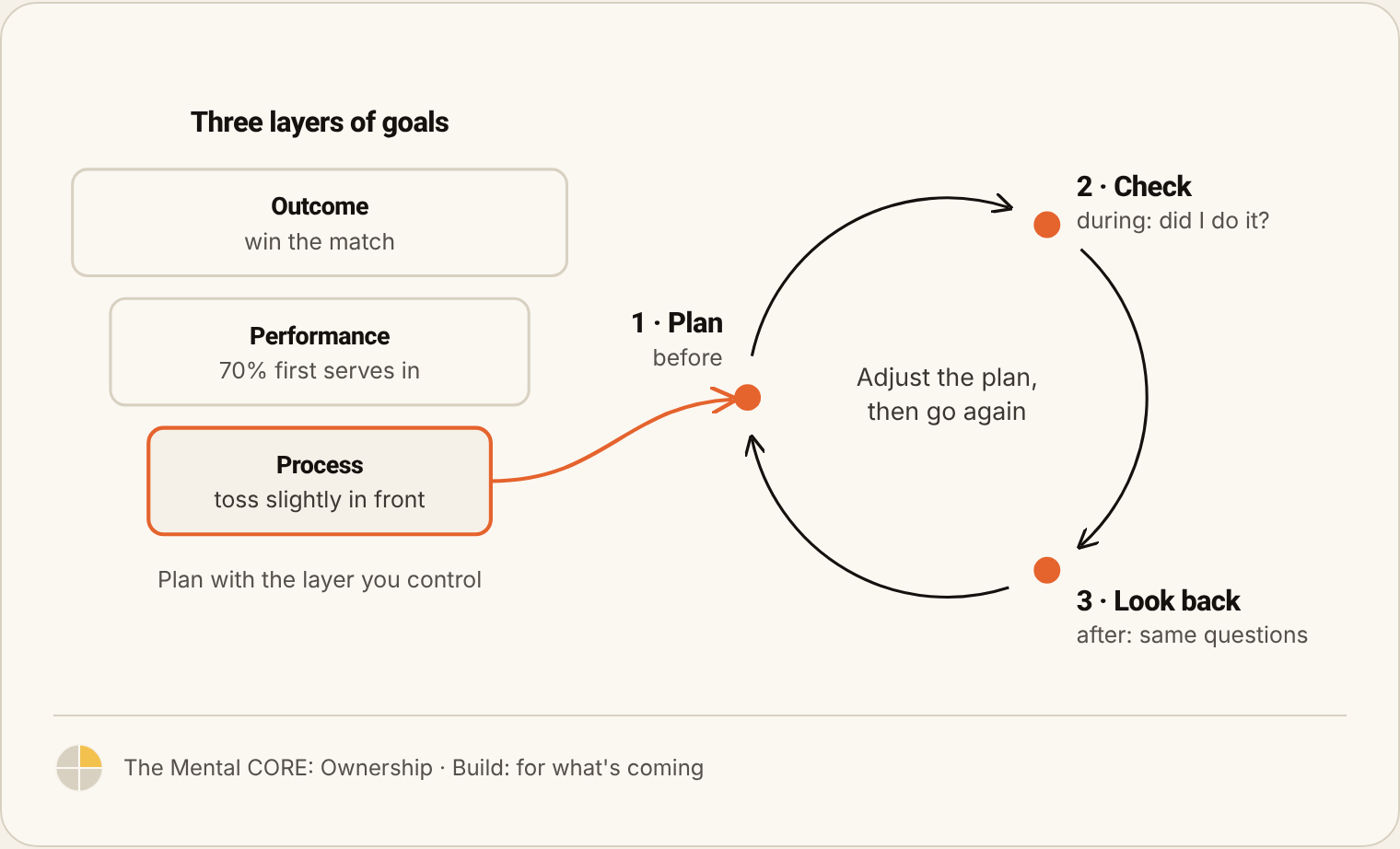
(1) Before you start: plan. Your goal tells you what to work on; now you plan the sessions that get you there. Not "have a good session" or "win the training", but something process-focused, like "turn my hips early on the forehand". The trap: everything feels important. Set priorities: pick one thing you can control, then make it smaller. "Improve my serve" sounds good, but a serve has many parts, so break it down. Write it down or tell a teammate; one minute is enough.
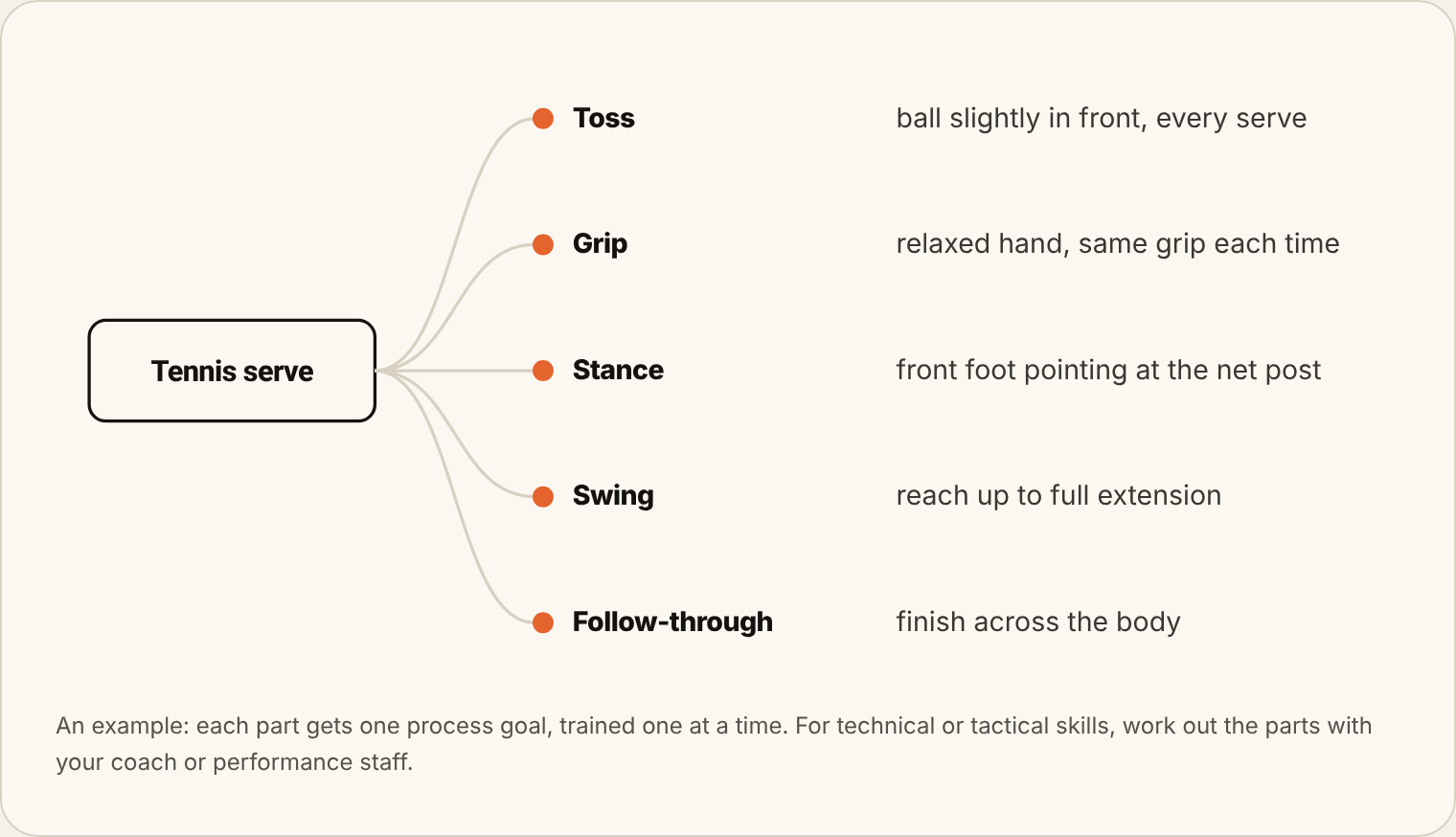
(2) While you're doing it: check. You focus on the process you set in step 1: are my hips turning? A lot is happening while you train, so use natural moments, like the breaks between drills, sets or intervals, for one quick question: did I do it?
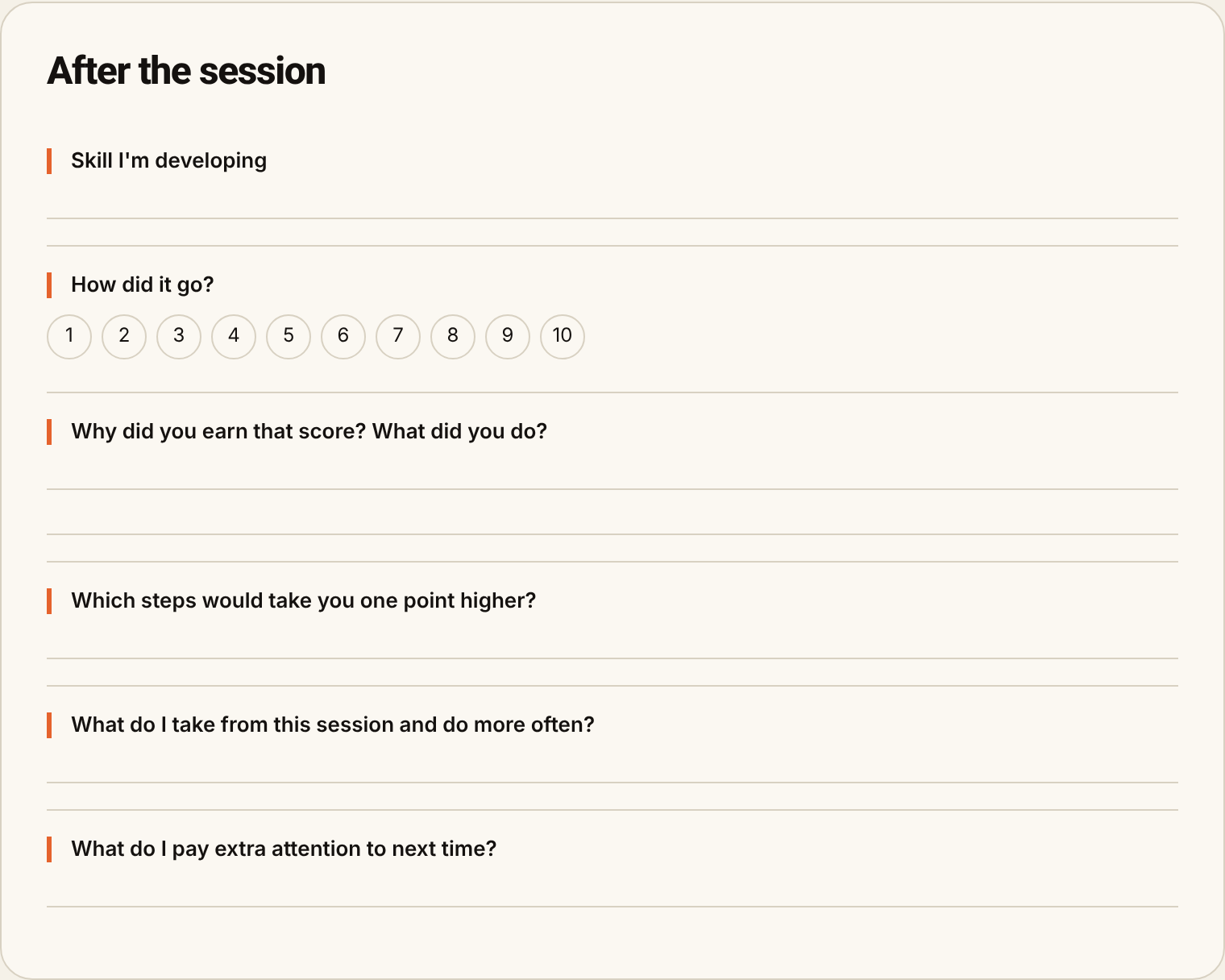
(3) Once you're done: look back. Reflection is where you try to be dead honest with yourself. Look at what you did, or didn't do, more than at the result. Why did it happen? What went well? What should change? Timing matters too. Some athletes reflect straight after practice or competition, others before they go to bed. Give yourself a few minutes and set up a fixed set of questions, so you answer the same ones every time and start to spot patterns.
Then what?
You adjust your plan, and the loop starts again. Over time you learn how you improve, what you've done that worked (or didn't), and where you're still stuck. Change the plan when nothing changes, since there's no point running into the same wall when you could climb over it. And expect a bumpy line with some disappointing moments rather than a smooth one going up. Treat a mistake as information for your plan.
What I usually tell athletes: don't just show up at practice and go through it. Go in with intention, knowing what you want to improve and which (long-term) goal it serves. It also shifts your attention from the score to your own actions, because that's what you learn to analyse.
Back to the end of that session. The athlete with the question and the athlete with the journal are deliberately working on getting better. For everyone else, it starts with one goal, a plan for your sessions and some time to reflect.
The Mental CORE · Ownership · Build: for what's coming
Thorben Meijer, MSc Coaching and Positive Psychology, mental performance coach near Zürich. Follow me on LinkedIn.
Sources
- Ericsson, K. A., Krampe, R. T., & Tesch-Römer, C. (1993). The role of deliberate practice in the acquisition of expert performance. Psychological Review, 100, 363–406.
- Hardy, L., Jones, G., & Gould, D. (1996). Understanding psychological preparation for sport: Theory and practice of elite performers. Wiley.
- Macnamara, B. N., & Maitra, M. (2019). The role of deliberate practice in expert performance: revisiting Ericsson, Krampe & Tesch-Römer (1993). Royal Society Open Science, 6, 190327. https://doi.org/10.1098/rsos.190327
- Reverberi, E., Gozzoli, C., D'Angelo, C., Lanz, M., & Sorgente, A. (2021). The Self-Regulation of Learning – Self-Report Scale for Sport Practice: validation of an Italian version for football. Frontiers in Psychology, 12, 604852. https://doi.org/10.3389/fpsyg.2021.604852
- Toering, T. T., Elferink-Gemser, M. T., Jordet, G., & Visscher, C. (2009). Self-regulation and performance level of elite and non-elite youth soccer players. Journal of Sports Sciences, 27, 1509–1517. https://doi.org/10.1080/02640410903369919
- Williamson, O., Swann, C., et al. (2022). The performance and psychological effects of goal setting in sport: a systematic review and meta-analysis. International Review of Sport and Exercise Psychology. https://doi.org/10.1080/1750984x.2022.2116723
- Zimmerman, B. J. (2000). Attaining self-regulation: a social cognitive perspective. In M. Boekaerts, P. R. Pintrich, & M. Zeidner (Eds.), Handbook of self-regulation (pp. 13–39). Academic Press.