Mental training for athletes: not only for when something's wrong
Mental training isn’t only for when something’s wrong. Why athletes and performance staff can treat the mental side like S&C and physio: mostly building, sometimes resetting.
You train your physical core every week. Who trains your mental core?
Mental performance work isn't reserved for when something is wrong. Like physio, S&C and nutrition, in my experience it works best as an ongoing part of how you prepare. Mostly that means building for what's coming, and sometimes resetting for what's important now.
Who's writing this
I'm Thorben Meijer (MSc), a mental performance coach based near Zürich. I work with Olympic and professional athletes, directly and through the people around them: coaches, physios, S&C trainers and other performance staff. I’ve also worked with the Dutch Ministry of Defence and with sports students in vocational and higher education.
My work draws on performance, sport, social, positive and coaching psychology. Clinical questions, such as severe anxiety or trauma, go to clinical colleagues. Everything else is performance work, and that's what this blog is about.
How most athletes end up working with me
Most athletes contact me because something is going on right now. Confidence dipping. An injury. Conversations with their coach getting harder. The fun quietly leaking out of their sport.
We start there, because that's what matters now. And then most of them stay.
The issue that brought them in gets sorted, and the work changes. We look less at the moment and more at what's coming. What does it take to get the most out of yourself, and how can the mental side support everything else you do: training, recovery, nutrition, and your life outside sport?
There's a very practical side to it too. When something good or bad happens, you want to be ready. Planning in the middle of a moment is hard, and you'd rather spend that energy on making the right decision.
You don't need a diagnosis to work on your mind
In practice, mental and psychological work is still linked far more often to something being wrong than to getting better. What I find disappointing is that athletes’ wellbeing is usually discussed in the language of illness, which feeds stigma (Uphill, Sly and Swain, 2016).
I usually explain this with Corey Keyes's two-continuum model. Doing well mentally is one scale and mental illness is another, related but separate. You can flourish with a diagnosis, and feel flat or stuck without one. Uphill et al. (2016) see promise in the model for athletes, though measuring it well still needs work.
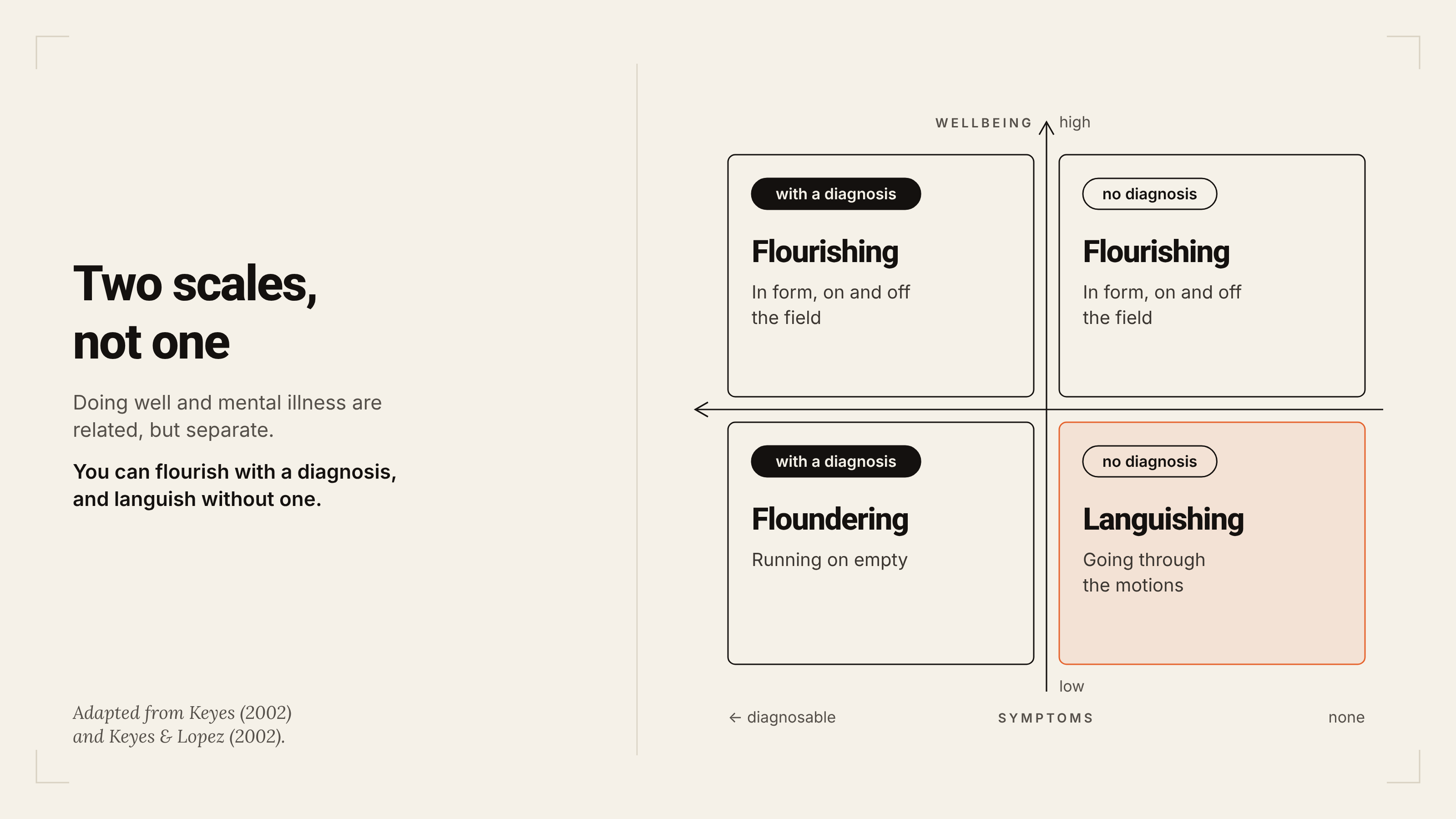
The International Society of Sport Psychology (ISSP) describes the same thing. Doing well mentally is more than the absence of illness, and athletes don't need a clinical disorder to need support (Henriksen et al., 2020).
When researchers talked with young elite athletes, working with a psychologist on performance or goal setting felt far more acceptable to them than seeking help for something like depression (Gulliver, Griffiths and Christensen, 2012). So the performance route is easier, but in practice, it’s often the door people only open once something has gone wrong.
Does mental training actually improve performance?
In 35 randomised controlled trials with close to 1,000 athletes, psychological and psychosocial interventions improved sport performance with a moderate effect. In the eight studies that checked back one to four weeks later, the effect was still there. What I find interesting for performance staff is that there was some evidence of bigger effects when coaches delivered the intervention (Brown and Fletcher, 2017).
Why the work happens before the moment
Whether it's a setback or a breakthrough, deciding what to do while you're in the middle of it is difficult. That's where planning ahead pays off, because you've already decided calmly what to do.
Research on if-then plans (in sport often called contingency planning; in research, implementation intentions: "If X happens, I'll do Y") found a solid effect on reaching goals across 94 tests (Gollwitzer and Sheeran, 2006). This wasn't a sport-exclusive study, so I'm borrowing here. But I think the mechanism travels well. When you make the decision before the pressure arrives, in the moment you mostly have to recognise the cue and focus on making the right decisions.
The Mental CORE and its two Performance Modes: Build and Reset
This is why my approach, The Mental CORE, has two Performance Modes.
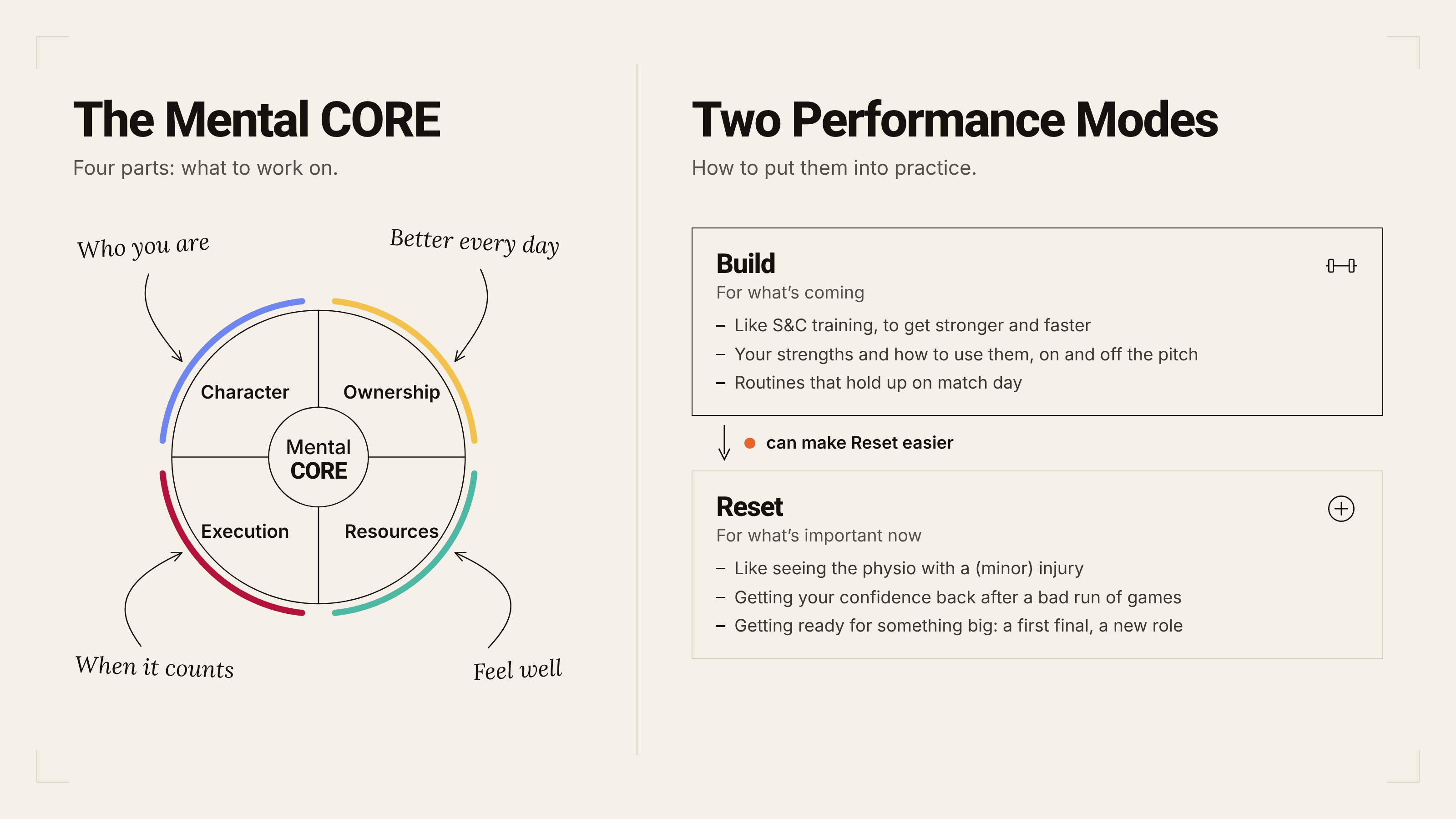
The Mental CORE is the foundation of how I work. It has four equal parts that together support sustainable performance. What we work on within each part isn’t set in stone. I adapt it to the person in front of me, so everyone gets what they need.
The four parts describe what to work on. The two Performance Modes turn it into practice. They show whether something needs attention right now, or whether we're working on what might be coming.
Mental CORE Build is for what’s coming. This is the structural work, like going to the weight room with your S&C coach to get stronger and faster. Ideally, we do most of our work here. You train all four parts, so you’re ready for what’s coming. That includes knowing your strengths, routines that hold up under pressure, a way of learning from what you do and experience, and a life and identity that aren’t only about your sport.
Mental CORE Reset is for what’s important now. Think of it like the physio, with treatment and recovery when something needs attention now, or getting you ready just before a big moment. In The Mental CORE, that attention goes to whichever part needs it most. That can be a setback, or a dip in confidence. But it can also be something good, like a first final or a new role.
When Build and Reset work together
Take a serious injury.
It’s a major setback for most athletes, and probably one to expect. I don’t have exact numbers, but I’d be surprised if many athletes get through a career without at least one nasty injury. That’s hard enough on its own. It can be confusing and disappointing, and it can drag you down. Needing time to process it makes sense.
With Build work behind you, the disappointment is still there, which is normal, I'd say. But you know what you can do next, and that gives you something to hold on to, and more control over a situation that feels out of your hands. And because you know who you are and what matters to you (outside sport), you have somewhere to stand while the sport itself is on hold.
Building like this can make a Reset easier. In my experience, the more self-awareness and skills you’ve built, the faster, more rationally and calmly you can respond when something happens. Plus, if you already work with someone, asking for help when something happens is a smaller step. The young elite athletes in the Gulliver study said much the same. Already knowing a provider, and having a coach who was open to mental support, made it easier for them to ask for help (Gulliver, Griffiths and Christensen, 2012). It was a small study, though.
What this means for performance staff
Think about how athletes use you. A physio doesn't only see injured athletes. An S&C trainer doesn't wait for a torn hamstring before the first session. Nobody would accept a wait-until-it-breaks model for the body.

Mental work doesn’t need a daily session the way S&C does. But your head is involved in everything you do, so I think it should be part of the performance mix, like the other specialisms.
So who on your team owns the mental side of an athlete who is doing fine? If it is nobody, or everybody a little, then the mental work probably starts when something has happened. And by then, everyone is planning in the middle of the moment. It's about preventing those moments where you can, or making sure they don't last too long.
Coaches have lots of influence here. Their attitude towards the mental side of performance can shape whether athletes ask for support, and whether they use mental work as a performance tool before anything goes wrong.
If your performance team hasn't answered the question: what are we doing for the athletes' mental side right now? And when do we do it? Only when something happens? Or because we believe it helps performance and we want our athletes (and staff) to keep improving, deliberately?
The Mental CORE · Build: for what's coming
Thorben Meijer, MSc Coaching and Positive Psychology, mental performance coach near Zürich. Follow me on LinkedIn.
Sources
- Brown, D. J., and Fletcher, D. (2017). Effects of psychological and psychosocial interventions on sport performance: A meta-analysis. Sports Medicine, 47(1), 77–99. https://doi.org/10.1007/s40279-016-0552-7
- Gollwitzer, P. M., and Sheeran, P. (2006). Implementation intentions and goal achievement: A meta-analysis of effects and processes. Advances in Experimental Social Psychology, 38, 69–119. https://doi.org/10.1016/S0065-2601(06)38002-1
- Gulliver, A., Griffiths, K. M., and Christensen, H. (2012). Barriers and facilitators to mental health help-seeking for young elite athletes: A qualitative study. BMC Psychiatry, 12, 157. https://doi.org/10.1186/1471-244X-12-157
- Henriksen, K., et al. (2020). Consensus statement on improving the mental health of high performance athletes. International Journal of Sport and Exercise Psychology, 18(5), 553–560. https://doi.org/10.1080/1612197X.2019.1570473
- Keyes, C. L. M. (2002). The mental health continuum: From languishing to flourishing in life. Journal of Health and Social Behavior, 43(2), 207–222. https://doi.org/10.2307/3090197
- Keyes, C. L. M., and Lopez, S. J. (2002). Toward a science of mental health: Positive directions in diagnosis and interventions. In C. R. Snyder and S. J. Lopez (Eds.), Handbook of positive psychology. Oxford University Press.
- Uphill, M., Sly, D., and Swain, J. (2016). From mental health to mental wealth in athletes: Looking back and moving forward. Frontiers in Psychology, 7, 935. https://doi.org/10.3389/fpsyg.2016.00935