Use your super-strengths, fix your boat-sinkers, park the rest
Focusing on strengths doesn't mean ignoring weaknesses. It means choosing where improvement time pays off most, and staff can help athletes find out where that is.
In sport, we want to get better, and so we focus a lot on what goes wrong. We test and we fix. When I start working with athletes, one of the first things I ask is to explain to me why they're so good at what they do, and what gives them the right to be confident. In most cases they find this hard to put into words, and would much rather tell me about their shortcomings. I'm guessing that in performance reviews, whether in sport or at the office, we mostly focus on what went wrong and what (or who) to blame. Let's see if we can do a little better.
Because there is another route: finding out what an athlete does best, and building on that. Research on strengths in elite sport (Ludlam et al., 2016, 2017) suggests this makes improvement more focused, because it forces a choice about which weaknesses really matter. Not every weakness is worth the attention.
What counts as a strength?
A strength is something you're good at and can use to perform. In sport it can be a personal quality, such as staying calm when things fall apart. Or an athletic one, such as a late burst of pace or reading the game early.
Positive psychology has studied strengths for more than twenty years, mostly as personality traits. The VIA survey is widely known and sorts 24 character strengths, such as perseverance and humour, into six virtues: wisdom, courage, humanity, justice, temperance and transcendence. It's a broad list and, to my knowledge, it isn't linked to athletes (yet), but it can help anyone improve areas of their life. Whether that's improving and performing in sport, or working with colleagues at the office.
Super-strengths: a weapon you should deliberately use
Katie Ludlam and colleagues interviewed seven sport psychologists and eight coaches who used a "super-strengths" approach with elite athletes in the UK. They defined a super-strength as a strategy for performance, built on something the athlete could become one of the best in the world at, to gain a competitive edge. Again, it can be a personal quality, an athletic one, or both.
In a follow-up study, elite athletes from field hockey, squash, cricket, rugby union and sailing looked back on working this way. They described more self-belief, clearer goals and training focus, more drive, and coping better under pressure. Several said it was the first time getting better wasn't mainly about their weaknesses. I like this angle for a simple reason: I see athletes light up when they realise what their strengths are. Which is odd, given that they're among the few who compete at this level. You'd think they'd have noticed, but a deficit-based approach is still common practice in sport (and at the office).
"Doesn't that make athletes less critical?"
This is the objection I hear most. If you focus on strengths, surely you stop working on what needs fixing?
The research says no, with a condition. The practitioners in Ludlam's study didn't ignore weaknesses. The aim was to learn which weaknesses are relevant to performance, and which are not. She called the relevant ones boat-sinkers: anything that cancels out a super-strength, which can also be a habit such as dwelling on mistakes (Ludlam, 2017). Kate Hays uses the same term in her book How to Win. Weaknesses that don't sink the boat can be parked.
So the critical eye stays. It just moves, from every visible flaw to the weaknesses that actually stand between the athlete (or employee) and the goal.
I saw this with a footballer I worked with. He spent a lot of time removing every small error from his game, including weaknesses that didn't matter much for where he wanted to go. For his perfectionist personality this was also very frustrating: only flaws, no good stuff (in his perception). We started looking at his strengths, in his football and in his personality, and at how he could use them on and off the pitch. His confidence grew, and so did the way he worked towards his goals.
Underuse, overuse and the golden mean
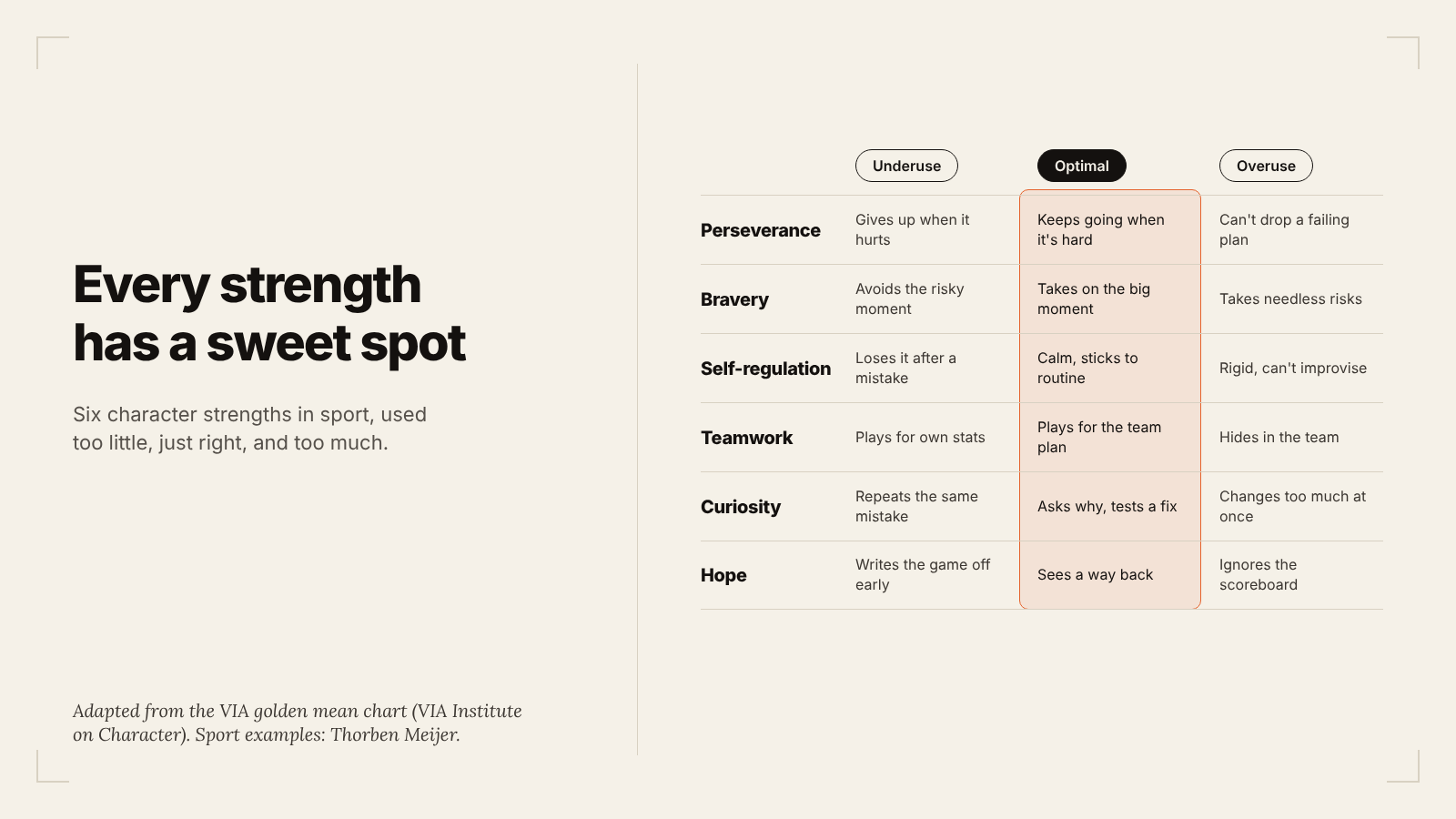
A strength can be underused or overused. Ludlam's athletes and coaches mapped it as a curve: from not using a strength at all to using it when it doesn't fit the situation (Ludlam, 2017). In positive psychology we call the sweet spot in between the golden mean (Niemiec, 2019). I like to think of it as a dimmer rather than an on/off switch: you can turn a strength up or down, depending on what the moment asks for. Research on leaders shows the same (Kaiser and Overfield, 2011). So figure out when a strength helps, and when it doesn't. For inspiration, see the examples of over- and underusing VIA strengths at the bottom of this page.

The aim is the right amount for the moment, which can mean dialling a strength down as well as up.
What staff can do on Monday
- Ask the athlete (or your colleagues) what they're best at, and what makes them different from others in their position. Expect athletes to be a bit uncomfortable talking about what they're good at, so don't take no or nothing for an answer :)
- Watch in training and competition, and outside the sport too. Check their behaviour and decision-making.
- Ask around: fellow staff, coaches, teammates, colleagues.
- Check the data: performance stats show strengths too.
Then make it specific. "Good job" gives someone little to work with. "You stayed calm when the plan fell apart" gives more info.
Together, build around how to use it. Include what the strength looks like according to the curve above, or the golden mean. Then give athletes, the people in your team and colleagues room to try, fail and adjust. And build in reminders: athletes said it slips without them.
Then build it into the training plan. In one example from the study, an athlete's super-strength was being the strongest in their sport, so the strength and conditioning programme was rebuilt around it. A tool that helps: the Strengths-Based Performance Profile (Castillo and Bird, 2021), a strengths-first version of the performance profile many staff already know.

The Mental CORE · Character · Build: for what's coming
Thorben Meijer, MSc Coaching and Positive Psychology, mental performance coach near Zürich. Follow me on LinkedIn.
Sources
- Castillo, E. A., & Bird, M. D. (2021). The Strengths-Based Performance Profile (SBPP): A method for strengths-spotting and application in single-session consultations with athletes. Journal of Sport Psychology in Action, 13(3), 180–194. Repository
- Hays, K. (2025). How to Win: Lessons in Success from the Front Line of Performance Psychology. HarperCollins. Chapter 3.
- Hays, K., Maynard, I., Thomas, O., & Bawden, M. (2007). Sources and types of confidence identified by world class sport performers. Journal of Applied Sport Psychology, 19, 434–456. https://doi.org/10.1080/10413200701599173
- Kaiser, R. B., & Overfield, D. V. (2011). Strengths, strengths overused, and lopsided leadership. Consulting Psychology Journal, 63(2), 89–109. https://doi.org/10.1037/a0024470
- Ludlam, K. E., Butt, J., Bawden, M., Lindsay, P., & Maynard, I. W. (2016). A strengths-based consultancy approach in elite sport: Exploring super-strengths. Journal of Applied Sport Psychology, 28(2), 216–233. Full text
- Ludlam, K. E., Bawden, M., Butt, J., Lindsay, P., & Maynard, I. W. (2017). Perceptions of engaging with a super-strengths approach in elite sport. Journal of Applied Sport Psychology, 29(3), 251–269. https://doi.org/10.1080/10413200.2016.1255278
- Ludlam, K. E. (2017). Super-strengths in elite sport (Doctoral thesis, Sheffield Hallam University). SHURA
- Niemiec, R. M. (2019). Finding the golden mean: The overuse, underuse, and optimal use of character strengths. Counselling Psychology Quarterly, 32(3–4), 453–471.
- Peterson, C., & Seligman, M. E. P. (2004). Character strengths and virtues: A handbook and classification. American Psychological Association.
- VIA Institute on Character. Finding the golden mean (chart). viacharacter.org. Sport examples adapted by Thorben Meijer.