What do you actually work on with a mental performance coach?
Mental training is more than focus under pressure. An overview of the four areas I work on with athletes, staff and teams, what sits in each, and the research behind it.
The S&C whiteboard says what today is for: legs, core, mobility. Nobody in the room wonders what S&C is and what to do. I wish it were the same for mental performance.
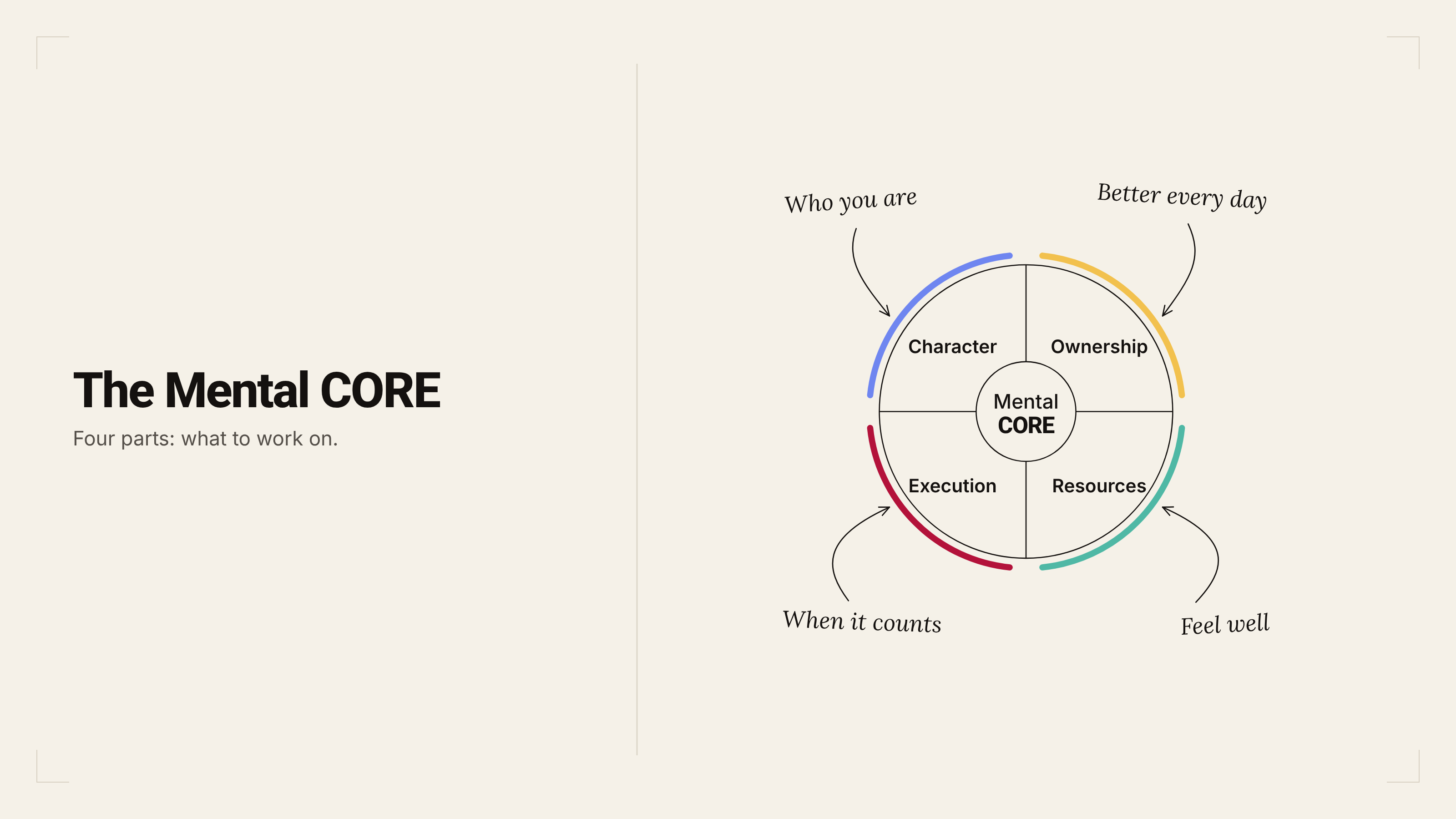
For me it's four areas. Who you are (Character), how you get better (Ownership), what keeps you well (Resources), and how you deliver when it counts (Execution). Together they form my approach, The Mental CORE. This is the overview, with what sits in each area, an example of the research behind it, and where to read more.
One approach, four equal parts
The Mental CORE has four equal parts, Character, Ownership, Resources and Execution. None of them comes first. What we work on inside each part isn’t set in stone either. I adapt it to the person or team in front of me. For that, I draw on several branches of psychology and methods.
A note before the list. The Mental CORE is my way of organising the work. It isn’t a tested theory, and I didn’t invent the ideas inside it. The parts have research matching the topics, some of it strong and some of it I took from outside a sports context, and I name an example as we go. That the mental side can be trained at all is better supported. A review of 30 meta-analyses found that techniques such as self-talk, imagery and goal setting improve sport performance, with a moderate effect on average (Lochbaum et al., 2022). The authors add that some studies are simple in design, though.
Character: who you are, what you want and need
Your values, strengths and identity, in your sport, your work and beyond.
- Strengths. Knowing what you’re good at and using it on purpose, such as the work on super-strengths in elite sport. So many people (and managers) focus solely on the flaws. That's discouraging, and you miss out on potential. Elite athletes who built their game around super-strengths reported more self-belief, clearer goals and a sharper focus in training (Ludlam et al., 2017; Ludlam et al., 2016).
- Personality. How you tend to think, feel and act, which researchers usually describe with the Big Five traits. Its link with sport performance is small (Yang et al., 2024), so I’d use it to understand yourself and leave the predicting alone. What it gives you is insight into why some situations drain you and others suit you, so you can plan around that.
- Values and identity. What matters to you, and who you are next to your job (whether this is being an athlete or any other professional). For the values part I borrow from ACT, in a coaching way. What do you want to stand for, also on a bad day? Then identity. Ask yourself who you are when you’re injured, on holiday or retired. If “an athlete” is the only answer, a lot rests on one thing. Researchers call this athletic identity. Swiss elite athletes who had built up other sides of themselves let go of it more quickly after their career (Schmid et al., 2024). Knowing what you stand for makes choices easier, and gives you something to stand on when sport or work goes badly.
- Behaviour and communication preferences. Understanding how you prefer to act and communicate, and knowing that other people have preferences of their own. That lets you tune how you work with them, without losing what makes you you. You notice it in fewer misunderstandings with your coach, teammates or colleagues, and in feedback that actually lands. Popular type tests make good dinner conversation and thin evidence, use them as a starter :).
What it gives you. You notice it in your choices. You know why you train or work the way you do, you use your strengths more on purpose, and you understand why some people get you straight away and others don’t.
The coming week, write down three things you value in life and one strength you could use more this week.
Ownership: better every day
Taking charge of your own progress, a little better every day.
- Learning from every session. Planning what you want from a session, checking yourself during it and looking back afterwards. We call this self-regulated learning (Zimmerman, 2000). Elite youth footballers reported more reflection than non-elite players (Toering et al., 2009). We don’t know yet what causes what. Reflecting more may help players reach the top, or playing at the top may make players reflect more.
- Goals. In work settings, specific, challenging goals beat “do your best” (Locke and Latham, 2002). In sport, the kind of goal seems to matter most. A process goal is about what you need to do. An outcome goal is about the result, like winning. Process goals had by far the largest effect on performance, and outcome goals almost none. Process goals also raised athletes’ belief that they could do it, probably because a process goal is in your own hands, which gives you a sense of autonomy and control. You can still want to win. You just focus on what you do (Williamson et al., 2022).
- Setbacks. How you explain a bad race or a not so smooth presentation at work to yourself. This race or every race, this part or everything, these reasons or “I’m just not good enough”. A way to explain this is explanatory style (Seligman et al., 1990).
- A shared standard in teams. How a team learns, gives feedback and deals with mistakes together. The best-known idea here is psychological safety (Edmondson, 1999), the feeling that you can speak up, ask a question or get it wrong without being punished for it. Elite sport adds a twist, because there mistakes do have consequences. Safe to speak up is not the same as safe to fail on match day (Taylor et al., 2025).
Why do it? When past sessions and projects feel like a blur. You know what you’re working on, you get more out of the same hours, and a bad day becomes information rather than you judging yourself. With ownership I want people to do-reflect-learn-improve, and do it again :). Your context shapes how you do this. Most athletes train more than they compete, while most people in an office job perform all week and rarely get to reflect and learn, let alone practise new skills outside the occasional offsite in the woods, mountains or other inspirational spot. So the learning has to be adapted to the circumstances, planned, and accepted as part of the work.
People need an environment where they feel safe and motivated to learn, and where the mistakes that come before getting better are allowed.
To start, after your next session or meeting, write down one thing that went well, one thing to change and what you’ll do next time.
Resources: feel well, perform well
The wellbeing that lets you handle pressure, use your abilities and enjoy what you do.
- Wellbeing. Doing well is more than having no complaints. Corey Keyes’s two-continuum model treats doing well and mental illness as two related but separate scales (Keyes, 2002). Simply put, you can have a diagnosis, like my ADHD, and still function well and feel well. For me, PERMA (Seligman, 2011) works as a practical checklist of what feeds it, with positive emotions, engagement, relationships, meaning and accomplishment.
- Motivation and your why. Self-determination theory (Ryan and Deci, 2000) describes three needs behind lasting motivation: (1) feeling capable, (2) feeling connected and (3) having a say in what you do. Athletes whose coaches supported their autonomy reported more self-driven motivation and higher wellbeing (Mossman et al., 2022). These are associations, so they don’t prove cause.
- Relationships. The people around you are a resource on many levels. Start with your coach. The 3+1Cs model describes the quality of that relationship through three Cs, closeness, commitment and complementarity. The +1 is co-orientation, how well coach and athlete understand each other’s view of those three (Jowett, 2025). Teammates and colleagues are the ones who know what a bad week feels like. A manager can make a heavy workload lighter or heavier. In a study, people with little support at work grew more emotionally exhausted over time (Aronsson et al., 2017). Outside sport and work, friends and family are where you don’t have to perform at all. What matters most is often knowing that support is there if you need it, more than how much you actually get (Freeman, 2021). And support isn’t automatically helpful. Teammates who keep going over what went wrong together tend to end up more stressed, not less (Kim et al., 2023). Support works best when it matches what the other needs (Arnold et al., 2018).
- Thoughts and emotions. Often it’s what you believe about an event that drives your reaction, more than the event itself. “I really want to win” and “I must win” lead to different nerves and different decisions. With REBT (Ellis, 1957), a cognitive-behavioural approach, we spot the rigid “must” beliefs and turn them into flexible preferences, so pressure leads to helpful nerves and clearer decisions instead of panic (Jordana et al., 2020). I use it in a coaching way.
The plus? Just feeling better. I find it sometimes hard to describe, but you feel it. Maybe it’s more energy. Maybe you have more left for the hard days, or you get back on your feet sooner after a bad day. Enjoying what you do can be an effect too, a topic that came up a lot during my studies in positive psychology. Under pressure there’s more in the tank, so it can be easier to push through or to make better decisions.
Next time, go through the five letters of PERMA and ask which one got the least attention this month.
Execution: under pressure
Delivering when it counts.
- How you respond under pressure. One way to approach this is through challenge and threat states (in sport, Jones et al., 2009). They describe whether you judge that you have what the moment asks of you. A challenge state tends to go with better performance, though the effects are small (Hase et al., 2019; 2025). What you believe about stress plays a part too. Athletes who saw stress as something that can help more often saw a moment as a challenge than as a threat (Mansell, 2021). In a workshop programme for young athletes, that belief shifted and negative feelings went down, though performance itself didn’t change (Mansell et al., 2023). The IZOF model adds that your best state is personal. One athlete needs loud hip-hop before a match, someone else needs ten quiet minutes of meditation before a big day at the office. In a meta-analysis, athletes whose pre-competition anxiety sat within their own optimal zone performed better than those outside it (Jokela and Hanin, 1999).
- Being prepared. A routine right before you perform is a set of thoughts and actions you run through on purpose, like a free-throw routine or the last minutes before a presentation. In a meta-analysis, routines helped both in calm practice conditions and when the pressure was on (Rupprecht et al., 2021). Deciding beforehand what you’ll do when things go differently belongs here too, whether that’s during a competition, on a stressful workday or in a call with a client that’s going badly.
- Focus and refocus. What do you tell yourself? Self-talk can enhance performance (Hatzigeorgiadis et al., 2011). “Focus!” shouted from the bench is usually not a refocusing plan ;)
- Flow. Those moments when everything clicks. You’re fully absorbed, time seems to disappear, and what you do feels almost automatic. Csikszentmihalyi (1990) called this flow. It tends to show up when the challenge matches your skills, you know exactly what you’re aiming for and you get direct feedback on how it’s going. Athletes who experienced more flow tended to perform better, though it isn’t clear which comes first (Harris et al., 2021). You can’t switch it on, but you can make it more likely.
- Accept and go on. Staying with the task while you feel your hands shaking or forget the words you want to say while leading your first team meeting. Mistakes and doubt will be there. Even the people we call the best have them. The question is what you do with those nerves, and how long you stay with those thoughts before you move on and focus on what you need to do. Approaches such as ACT (Hayes, Strosahl and Wilson, 1999), and the Mindfulness-Acceptance-Commitment approach (MAC) designed for sport (Gardner and Moore, 2004), work on exactly this. For performance the results are promising, but not yet stable (Reinebo et al., 2024; Ptáček et al., 2023).
Prepare! Don't let pressure just happen to you. Find out how you react under pressure, create a routine to fall back on and a plan for when things go differently. The more you train or prepare this, the more it shows up when it counts.
What can you do right now? Think back to the last moment you felt the pressure, but you were able to perform well. What did you do in the ten minutes before, and what would you keep?
When you work on what
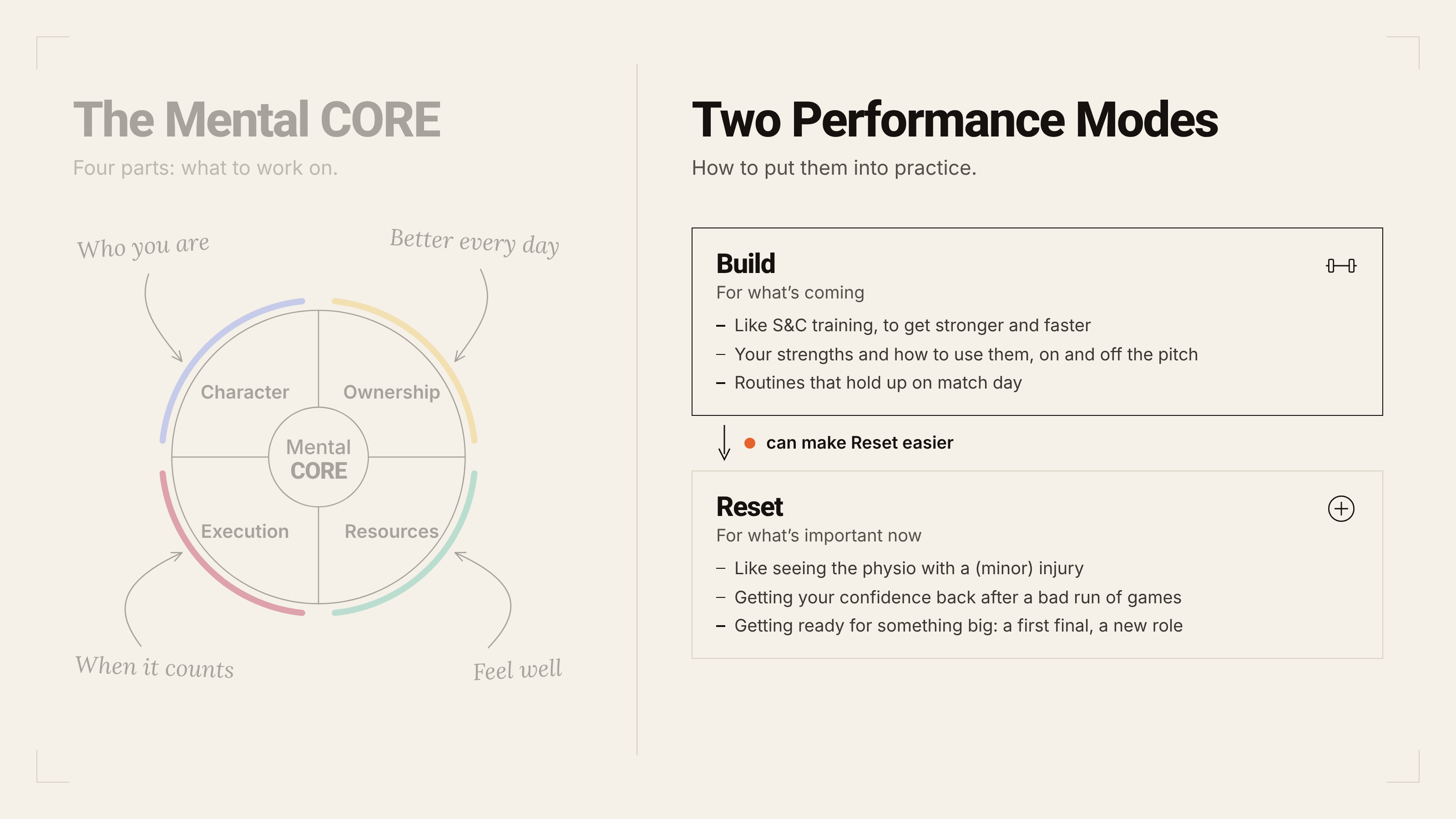
The four parts tell you what to work on. But when? This is simpler than it sounds. I start by asking what you want to talk about today. What’s important now? What’s going on, good or bad, that keeps you from performing the way you can? If there is something, we dive into that and Reset. When nothing is pressing, we Build for what’s coming. Ideally, most of the work is Build. Together I call them my two Performance Modes.
Where it stops
I don’t diagnose, and I don’t work on reducing symptoms. Clinical questions go to clinical colleagues. A diagnosis doesn’t keep you out, though. I work with people with ADHD, autism or a brain injury too, and I know some of it from the inside. I have ADHD myself, and I went through rehab after a brain injury. There's still a lot you can offer! For example, neurodivergent people often have what’s called a spiky profile, with clear peaks next to the dips. The peaks are there. You, the people around you and your environment need to know how to activate them.
If your picture of mental training was the penalty, the start line or pitching your new start-up, that was just one of the four. So which of the four would you have the least to say about? That’s where I’d begin. And if you’d rather think it through out loud with someone, send me a message.
The Mental CORE · Build: for what’s coming · Reset: for what’s important now
Thorben Meijer, MSc Coaching and Positive Psychology, mental performance coach near Zürich. Follow me on LinkedIn.
Sources
- Arnold, R., et al. (2018). Organizational stressors, social support, and implications for subjective performance in high-level sport. Psychology of Sport and Exercise.
- Aronsson, G., Theorell, T., Grape, T., Hammarström, A., Hogstedt, C., Marteinsdottir, I., Skoog, I., Träskman-Bendz, L., and Hall, C. (2017). A systematic review including meta-analysis of work environment and burnout symptoms. BMC Public Health, 17, 264. https://doi.org/10.1186/s12889-017-4153-7
- Csikszentmihalyi, M. (1990). Flow: The psychology of optimal experience. Harper & Row.
- Edmondson, A. (1999). Psychological safety and learning behavior in work teams. Administrative Science Quarterly.
- Ellis, A. (1957). Rational psychotherapy and individual psychology. Journal of Individual Psychology.
- Freeman, P. (2021). Social support. In an edited Routledge volume on sport psychology.
- Gardner, F. L., and Moore, Z. E. (2004). A mindfulness-acceptance-commitment-based approach to athletic performance enhancement: Theoretical considerations. Behavior Therapy.
- Harris, D. J., et al. (2021). A systematic review and meta-analysis of the relationship between flow states and performance. International Review of Sport and Exercise Psychology.
- Hase, A., et al. (2019). The relationship between challenge and threat states and performance: A systematic review. Sport, Exercise, and Performance Psychology.
- Hase, A., Nietschke, M., Kloskowski, M., Szymanski, K., Moore, L., Jamieson, J. P., and Behnke, M. (2025). The effects of challenge and threat states on performance outcomes: An updated review and meta-analysis of recent findings. EXCLI Journal, 24, 151–176. https://doi.org/10.17179/excli2024-7995
- Hatzigeorgiadis, A., Zourbanos, N., Galanis, E., and Theodorakis, Y. (2011). Self-talk and sports performance: A meta-analysis. Perspectives on Psychological Science, 6(4), 348–356. https://doi.org/10.1177/1745691611413136
- Hayes, S. C., Strosahl, K. D., and Wilson, K. G. (1999). Acceptance and commitment therapy: An experiential approach to behavior change. Guilford Press.
- Jokela, M., and Hanin, Y. L. (1999). Does the individual zones of optimal functioning model discriminate between successful and less successful athletes? A meta-analysis. Journal of Sports Sciences, 17(11), 873–887. https://doi.org/10.1080/026404199365434
- Jones, M. V., Meijen, C., McCarthy, P. J., and Sheffield, D. (2009). A theory of challenge and threat states in athletes. International Review of Sport and Exercise Psychology.
- Jordana, A., et al. (2020). A systematic mapping review on the use of Rational Emotive Behavior Therapy (REBT) with athletes. International Review of Sport and Exercise Psychology.
- Jowett, S. (2025). 25 years of relationship research in sport: The quality of the coach-athlete relationship as defined by Closeness, Commitment, Complementarity and Co-orientation (3+1Cs Model). Psychology of Sport and Exercise, 80, 102909. https://doi.org/10.1016/j.psychsport.2025.102909
- Keyes, C. L. M. (2002). The mental health continuum: From languishing to flourishing in life. Journal of Health and Social Behavior, 43(2), 207–222. https://doi.org/10.2307/3090197
- Kim, J., et al. (2023). “I hate it when that happens too!”: Observed and perceived exchanges of social support between university student-athletes during discussions of stressors. International Journal of Sport and Exercise Psychology.
- Lochbaum, M., Stoner, E., Hefner, T., Cooper, S., Lane, A. M., and Terry, P. C. (2022). Sport psychology and performance meta-analyses: A systematic review of the literature. PLoS ONE, 17(2), e0263408. https://doi.org/10.1371/journal.pone.0263408
- Locke, E. A., and Latham, G. P. (2002). Building a practically useful theory of goal setting and task motivation: A 35-year odyssey. American Psychologist, 57(9), 705–717. https://doi.org/10.1037/0003-066X.57.9.705
- Ludlam, K. E., Butt, J., Bawden, M., Lindsay, P., and Maynard, I. W. (2016). A strengths-based consultancy approach in elite sport: Exploring super-strengths. Journal of Applied Sport Psychology. https://core.ac.uk/download/42541299.pdf
- Ludlam, K. E., Bawden, M., Butt, J., Lindsay, P., and Maynard, I. W. (2017). Perceptions of engaging with a super-strengths approach in elite sport. Journal of Applied Sport Psychology.
- Mansell, P. C. (2021). Stress mindset in athletes: Investigating the relationships between beliefs, challenge and threat with psychological wellbeing. Psychology of Sport and Exercise.
- Mansell, P. C., et al. (2023). “Mindset: performing under pressure”: A multimodal cognitive-behavioural intervention to enhance the well-being and performance of young athletes. Journal of Applied Sport Psychology.
- Mossman, L. H., et al. (2022). Autonomy support in sport and exercise settings: A systematic review and meta-analysis. International Review of Sport and Exercise Psychology.
- Ptáček, M., et al. (2023). Effectiveness of the mindfulness–acceptance–commitment approach: A meta-analysis. International Journal of Sport and Exercise Psychology.
- Reinebo, G., Alfonsson, S., Jansson-Fröjmark, M., Rozental, A., and Lundgren, T. (2024). Effects of psychological interventions to enhance athletic performance: A systematic review and meta-analysis. Sports Medicine, 54(2), 347–373. https://doi.org/10.1007/s40279-023-01931-z
- Rupprecht, A. G. O., et al. (2021). The effectiveness of pre-performance routines in sports: A meta-analysis. International Review of Sport and Exercise Psychology.
- Ryan, R. M., and Deci, E. L. (2000). Self-determination theory and the facilitation of intrinsic motivation, social development, and well-being. American Psychologist, 55(1), 68–78. https://doi.org/10.1037/0003-066X.55.1.68
- Schmid, M. J., et al. (2024). Leaving elite sport, abandoning athletic identity? Development and predictors of athletic identity post-retirement. German Journal of Exercise and Sport Research.
- Seligman, M. E. P., Nolen-Hoeksema, S., Thornton, N., and Thornton, K. M. (1990). Explanatory style as a mechanism of disappointing athletic performance. Psychological Science. PDF
- Seligman, M. E. P. (2011). Flourish. Free Press.
- Taylor, J. A., et al. (2025). Performance safety: Conceptualising psychological safety when errors have consequences. Journal of Applied Sport Psychology.
- Toering, T. T., Elferink-Gemser, M. T., Jordet, G., and Visscher, C. (2009). Self-regulation and performance level of elite and non-elite youth soccer players. Journal of Sports Sciences, 27(14), 1509–1517. https://doi.org/10.1080/02640410903369919
- Williamson, O., et al. (2022). The performance and psychological effects of goal setting in sport: A systematic review and meta-analysis. International Review of Sport and Exercise Psychology. https://doi.org/10.1080/1750984X.2022.2116723
- Yang, J.-H., Yang, H. J., Choi, C., and Bum, C.-H. (2024). Relationship between athletes’ Big Five model of personality and athletic performance: Meta-analysis. Behavioral Sciences, 14(1), 71. https://doi.org/10.3390/bs14010071
- Zimmerman, B. J. (2000). Attaining self-regulation: A social cognitive perspective. In M. Boekaerts, P. R. Pintrich and M. Zeidner (Eds.), Handbook of self-regulation.